Blockades, blending, and the politics of belonging
Also 🌺 Belated Happy Onam, folks! 🌾🌾


Hello DoorDesi,
Another Sunday, another issue. And here you are, reading it. Thank you! I mean it.
This weekend I have been thinking about an uncomfortable and politicised topic - assimilation. What does it take to assimilate, what does it mean to assimilate in a different culture.
I have been living in the Netherlands for 7 years. I have Dutch friends, I speak decent Dutch, I am quite well travelled in the country, I even vote in the local elections (the only one I can vote in without citizenship). Do I feel fully assimilated? Let’s explore.
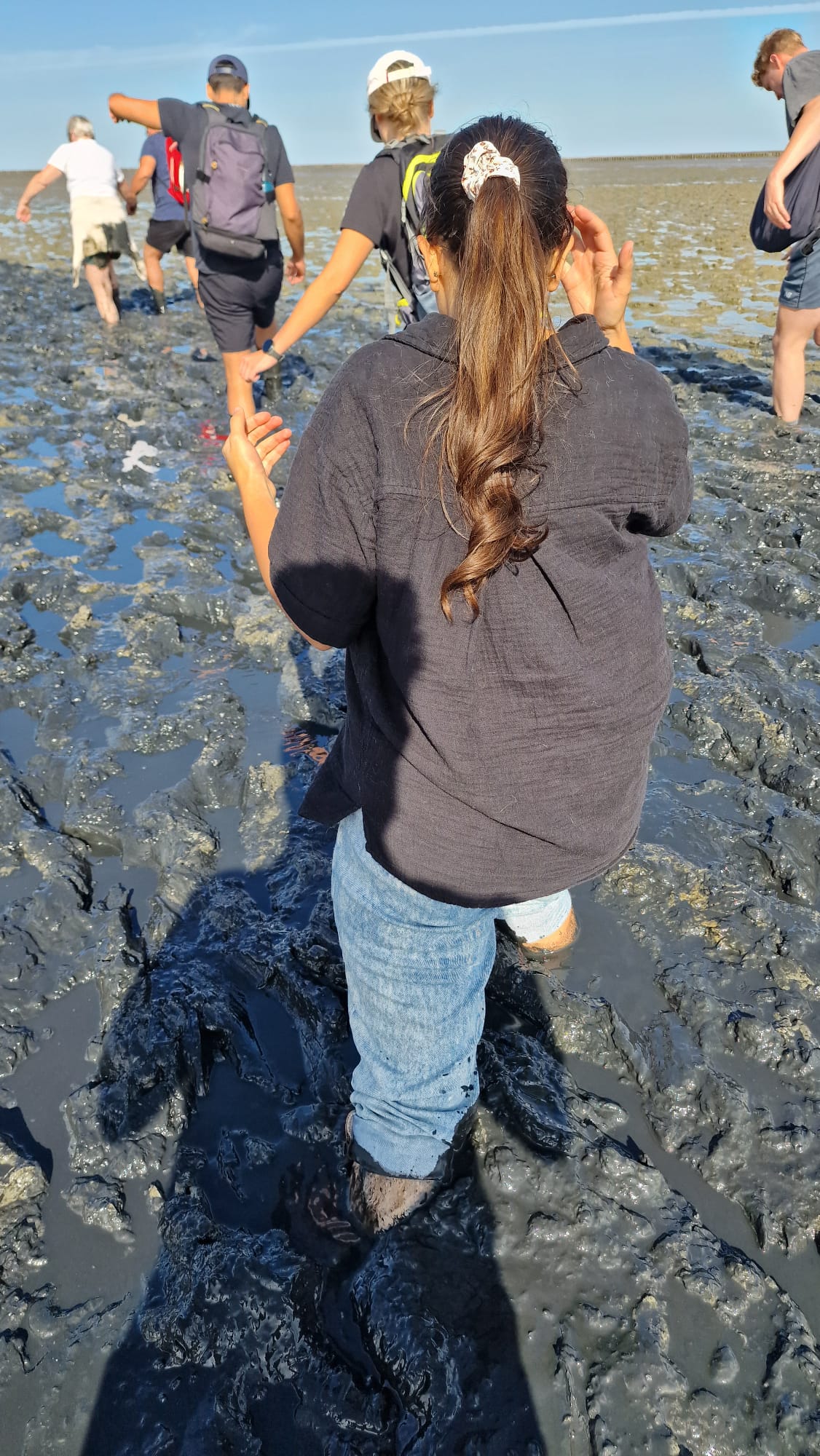
But yesterday, my partner and I went for a very Dutch activity. Wadlopen (tidal mudflat hiking). It was on my wishlist for the past 7 years and later this year I turn 30 so I wanted to check it off my bucketlist before that. So I did. Anyway, we went all the way to the northern edge of the country to walk in mud - knee deep in mud. Yes, you heard me.
Anyway, the point is, there we were, and I noticed that I was literally (not kidding) the only racially non-Dutch person. In our group of 41 hikers, I was the tiniest, darkest person. But I felt right at home. I did not expect them to switch to English for me, they did not expect me to drown simply because I was half their heights.
And during that walk, while trying to pull myself out of thigh deep mud, this very non-profound, obvious, but equally important realisation came to me. Assimilation goes both ways. Often in this discussion one party blames the other. ‘Immigrants don’t assimilate into OUR culture‘, ‘the locals are too closed and don’t let US in’. Both can be true and untrue at the same time.
Assimilation, I realised, isn’t a box you tick once and for all. It’s a slow dance, sometimes you lead, sometimes you follow, and sometimes you just get stuck in the mud together. It is not about erasing differences, but about showing up in shared spaces without demanding that everyone else bend to you, or that you bend yourself out of shape.
And maybe that’s the trick: to keep looking for moments, even silly ones, like waddling across the Waddenzee, where you feel part of the whole without losing the parts that make you you.
So this week, instead of offering a neat definition of assimilation, I’ll just leave you with the image of me, caked in Dutch mud, having the time of my life with 39 complete strangers.
Just the gist
🔗The Coalition of the ‘I need you and don’t trust you at the same time’
India is back in Europe’s WhatsApp group chat. PM Modi had a “very good conversation“ with EU chiefs Ursula von der Leyen and Antonio Costa to talk shop: wrap up the long-pending India–EU free trade agreement, push the India-Middle East-Economic trade corridor (IMEEC), and figure out how to stop Ukraine from burning, 4 years in. Meanwhile, Jaishankar assured Kyiv that India supports “just peace” and promised more hugs at the upcoming UNGA. For Brussels, India is the friend who insists it wants peace while also buying Russian oil - you know the friend who promises they will not be friends with your ex but secretly are. For Delhi, Europe is both a trade jackpot and the uncle who tells you how he made better choices than you when he was your age but deep down you know uncle was catcalling his neighbour’s daughter on the daily (i.e., you are not my moral superior).
➡️ India is increasingly playing Europe and North America at their own games and double standards, establishing itself as a partner the global north wants to woo. What this means for our moral compass, one that we were known to have in the past, is a different conversation.
After seven years of frost, Modi showed up in China for the 25th Shanghai Cooperation Organisation (SCO) Summit, sharing smiles with Xi and Putin like it was 2015 all over again. India used the SCO summit to remind the world that it still plays its favourite foreign policy sport: balancing on a tightrope.
The visit signalled more than troop disengagements along the LAC — direct flights, visa easing, and economic ties are back on the table. Modi also reaffirmed ties with Putin, complete with a joyride in the Russian president’s limo. The takeaway from this is energy and defence deals are alive and well. China’s Border and Roads Initiative still does not have India’s blessing, of course.
With the U.S. throwing tariff tantrums, this is clearly India keeping its options open.
➡️ India has been isolating itself from its neighbours for a while now. This is a hopeful sign that in our race to become Vishwaguru we are not going to end up completely alone in our neck of the woods. And who knows, this might affect your remittances as well - i.e., keep an eye on the exchange rate. (103.29INR = 1EUR as of this morning)
🔗One man’s energy security, another man’s financial insecurity
India’s big bet on ethanol-blended petrol (E20) is already saving billions in oil imports and boosting sugarcane farmers, but for car owners the ride feels bumpier. Drivers complain of clogged injectors, corroded seals, weaker mileage, and engines that suddenly feel like they’ve aged a decade. A survey of 37,000 motorists found nearly two-thirds saw fuel efficiency drop, especially in older cars. The government insists E20 is the path to energy security, pointing to Brazil’s eventual success, but critics warn it risks food security, air quality, and vehicle performance and of course that comes with a side of ‘make the rich richer on the backs of the common man’.
➡️ I feel that a lot of this administration’s moves are based in this ‘move fast, break things’ mentality borrowed from Silicon Valley. Let’s just roll this out and if it fails, welps, we’ll try something else. Well, this works with app development because what’s the worst that can happen? But when it comes to public policy and governance for the most populous country in the world, this model doesn’t work. Obviously! If you disagree with me, please write to me. I would love to hear what y’all think.
The Supreme Court has hit pause on the PR reel of Vantara, Anant Ambani’s much-hyped animal rescue park, and handed the script to a Special Investigation Team led by ex-Justice J. Chelameswar. On its plate: everything from whether elephants were legally acquired to if Jamnagar’s heat is torturing imported species, plus whispers of smuggling, shady finances, and “vanity zoo” vibes. No sh!t, Sherlock!
The SIT includes a former police chief and customs official, giving this probe more teeth than your average case. They’ve got till September 12 to report back. (So let’s check back in next week, shall we?).
➡️ This move gives us the slightest hope that the ultra wealthy of the nation are not that immune to scrutiny and there might after all be a way to hold them accountable. More on this next week when the SIT report comes out.
🔗Of Berlin Walls and ethnic strife
I bring you back to Manipur because let’s now forget it. So, the Free Movement Regime allowed free movement of people across the Indian-Myanmar border upto 16kms. Now the Naga and Kuki communities have familial relations and ethnic similarities with folks across the border but the Meitei community believes that this free movement has been a gateway for drugs, illegal migration, and also the what stoked recent violence in Manipur.
In Feb our Home Ministry announced the suspension of the FMR. A border fence is also being raised between India and Myanmar. This, naturally does not have the support of ethnic communities with familial relations across the border.
The Centre struck a deal with Kuki groups to ease movement on NH-2, but the United Naga Council has now announced a trade embargo from September 8 over the border fence and the suspension of the Free Movement Regime with Myanmar. That’s bad news for Imphal Valley, which depends on highways through Naga areas for essentials. While Kukis liken the fence to a “Berlin Wall,” Meiteis see FMR as a gateway for migration and drugs. The government is scrambling before another blockade hits.
➡️ I am fascinated by how little I know and how much I learn about India’s borderland. If there are specific regions you would like to learn about with me, please drop me a message. This isn’t just about learning more about India, it is also about learning about the people we live amongst in this world.
Keeping up with the internet
🔗The less fun part of the internet
The new Digital Personal Data Protection Act is being sold as privacy reform, but its sharpest edge cuts through journalism and RTI. By lumping reporters with “data fiduciaries,” it makes every name, tape, and document a compliance trap—where consent notices replace stings, and erasure requests erase accountability. The RTI override that once let public interest trump privacy is gone too, meaning files like Adarsh, 2G or Panama can now be locked away with a “personal data” stamp. Add unchecked government power to demand newsroom records, and you’ve built a system where whistleblowers disappear and small newsrooms drown in paperwork.
➡️ The Internet Freedom Foundation has been my go-to when it comes to following shutdowns across the country, data rights of individuals, and all things internet in India. They are a fantastic and passionate team of individuals who put a lot on the line to ensure that India’s internet does not become like the Chinese or Russian or Iranian or many other heavily censored and monitored internet spaces. I just wanted to highlight their work for you guys!
Desi culture
In a world obsessed with flying private jets to billion-dollar climate summits, a women’s group from a small village in Karnataka has flipped the script. The Bibi Fatima Women’s Self-Help Group from Teertha has won the UNDP Equator Prize 2025 for reviving millets, running community seed banks, and turning eco-farming into women-led businesses. Through natural, chemical-free farming methods, the group has restored biodiversity and improved food security across approximately 30 villages. From ragi dosa mix to herbal soaps, they’ve built an economy rooted in resilience and tradition, while directly benefiting over 5,000 farmers. Their win is proof that real climate leadership can start in a drought-prone field, powered by dialogue, solar mills, and grassroots efforts.
➡️ Grassroots movements towards climate resililence seem to be the only kind of movements that work. Not of the top-down ‘we talked about this over caviar and expensive wine’ policies with no sense of the ground reality of the people. I want to highlight more such grassroots movements so if you know of any in your hometown, home-state, please send them to me. :)
💌 Community feature
Every week, one of you sends a little postcard from your DoorDesi life — a snapshot, a story, a moment worth sharing. Think of it as our way of waving hello across cities, countries, and dosa queues.
This week we encountered some delays so keep an eye out for next week!
To share your own postcard with the rest of us, drop us an email or drop me a message!
With love on behalf of two women who cringe at the mention of chai tea latte,
Sudeshna
Co-Founder, DoorDesi 💃
Housekeeping
If this was forwarded to you, subscribe here.
Help us hit our goal of 1000 subs by August 15, would you forward it to a friend?
If you can’t find the newsletter, check your spam folder. And please mark this address as ‘not spam.’ If the newsletter isn’t in your spam folder, either, you should look in the Promotions tab.